
Forget “More Data” for Virtual Cells — We Need Better Data. Introducing VCPI
‘More is better’ has become the reigning mantra in AI research. But for AI drug discovery, it’s better data that will move the needle. We’ve launched the Virtual Cell Pharmacology Initiative (VCPI) to build that better data in a first-of-its-kind community-led effort. We’re using DRUG-seq: high-throughput, arrayed screening, backed by $1B in automation and a standardized cell line. Even better, we’re gifting 100,000 compounds of high-quality RNA profiling data and asking the community to choose the compounds. Inside: our mission to build the future of Virtual Cells — and transform bio-AI — together.
Imagine you're standing in a lab, looking at an assortment of pills in your palm—reds, blues, oranges. You have a dozen drugs, and you're about to test their pharmacological activity on the cage of mice sitting on the bench in front of you.
Extending your arm, you sprinkle the pills into the cage. The mice scamper and gobble them up. Tomorrow, you’ll come back to take measurements.
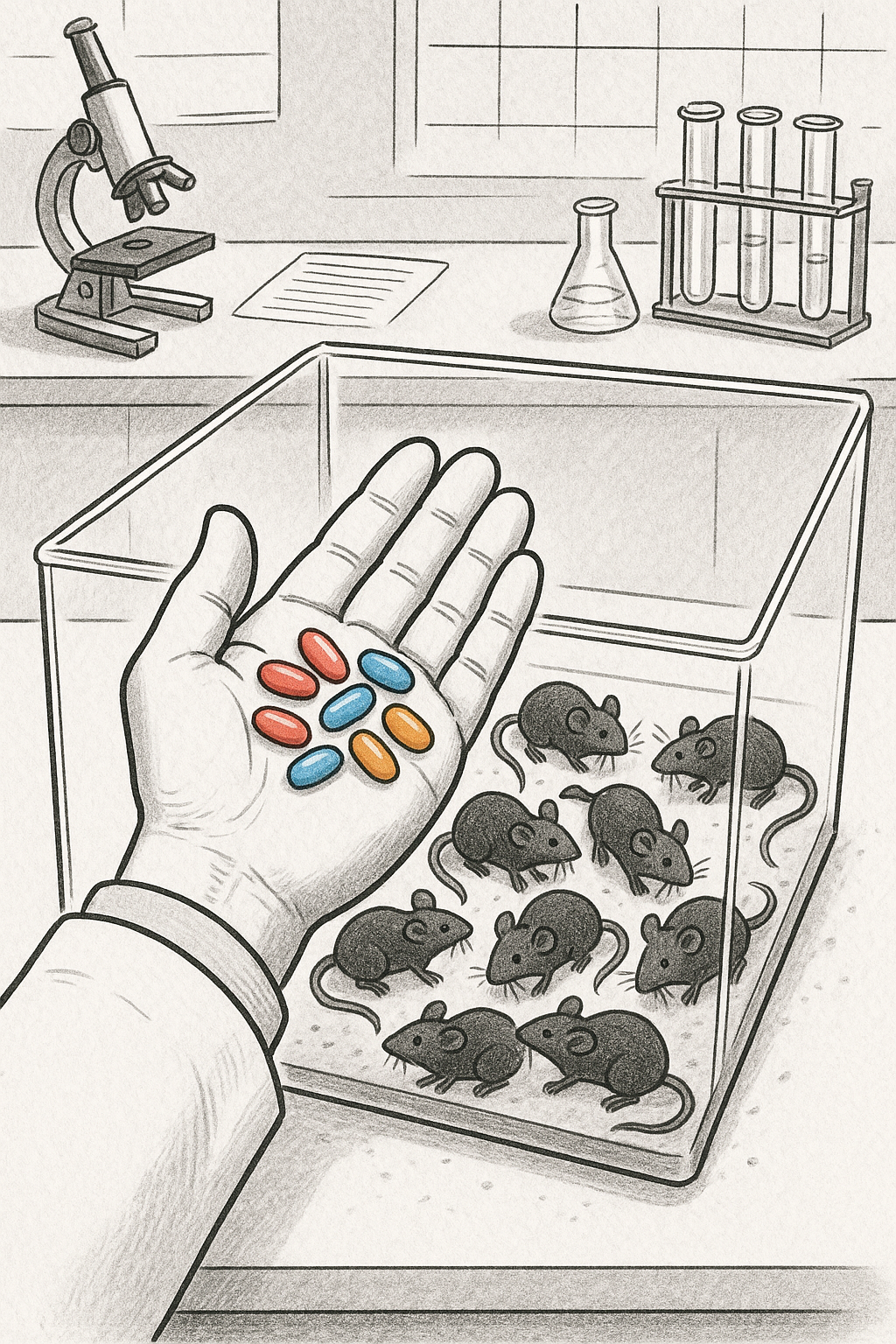
There’s only one problem (aside from the laughably bad dosing technique): you realize you won't know which mouse was treated with which drug. They're all in one cage. Some mice might have eaten multiple pills, others none. You'll have results, but you'll have no idea how to interpret them.
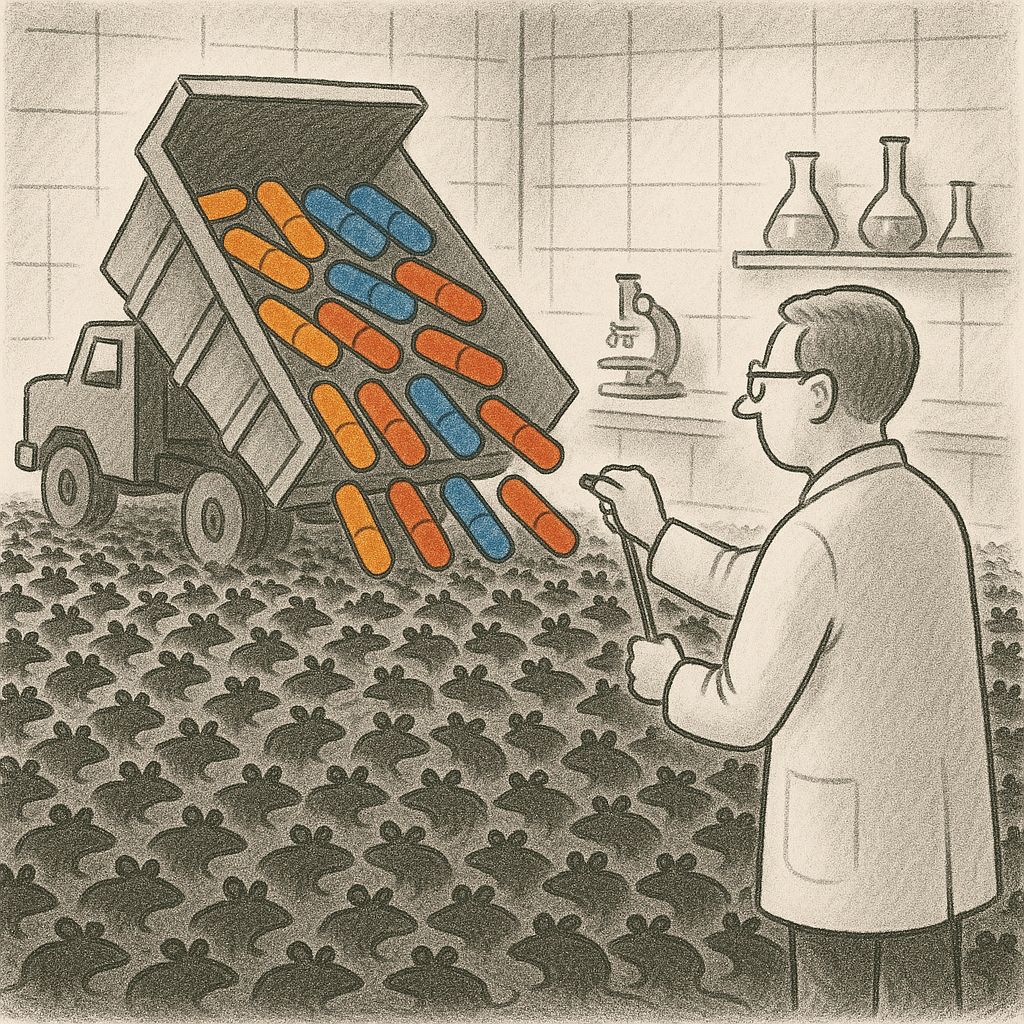
Now, what if you had 1 million mice? And a process to measure them all efficiently? The catch is, they all have to stay in one giant cage—maybe a shipping container. This would generate a massive dataset. Your AI scientists are salivating at the sheer volume of data.
Does that make the experimental design any better?
The Siren Call of Single-Cell
Single-cell sequencing is an incredible technique. It’s given us unprecedented insight into cellular heterogeneity and has been a game-changer for perturbation studies using CRISPR, where the sgRNA acts as a built-in barcode. These datasets are fantastic for training certain AI models… or maybe not (Kedzierska,Csendes, Ahlmann-Eltze). Jeremy Jenkins and I traded friendly barbs on this topic at the Datapoints Summit.
Regardless, it’s that pooled, "one-pot" setup that makes perturb-seq incredibly efficient. And that’s also the exact reason it’s not well-suited for pharmacology, for the same reason one giant cage of mice isn’t suitable for an in vivo study. Unless your drug has a barcode (and let's park DELs for another day), it's practically impossible to deconvolve which treatment caused which effect.
Groups have come up with creative ways to get around this, but the throughput for compound screening remains limited—on the order of 10s or 100s (maybe low 1000s but look closely at how many compounds pass quality filters). Traditional high-throughput screening (HTS) runs 100,000s to millions. To make up for this lost throughput, a hodgepodge of different cell types is often used in the pool, trading drug diversity for biological diversity.
This trick does increase the data volume, but it's like our mouse analogy again: splitting your 1M mice into a few cages, adding an equal number of rats and rabbits (why not?), treating each mixed cage with one type of pill, and just... hoping for the best.

A Better Way: DRUG-seq
There has to be a better way, right?
Yes. It’s called DRUG-seq.
Developed by Novartis originally, DRUG-seq is a miniaturized, high-throughput bulk sequencing method. You can think of it as the arrayed version of single-cell. Instead of adding a barcode to each cell, you add a barcode to each well of a 384-well plate.
You now essentially have 384 tiny, individual "cages" for your experiment—the way animal studies are actually run.
Ginkgo Datapoints is a leader in DRUG-seq services, with the ability to process at least 100 x 384-well plates a week, end-to-end. With >10,000 genes detected per well, that’s 384M data points per week. And we plan to scale even further. It’s our upstream automation that lets us truly unlock this technique's horsepower. We can do dose-response studies, a true reflection of pharmacology, at high throughput. We can use adherent cells, suspension cells, primary cells, you name it.
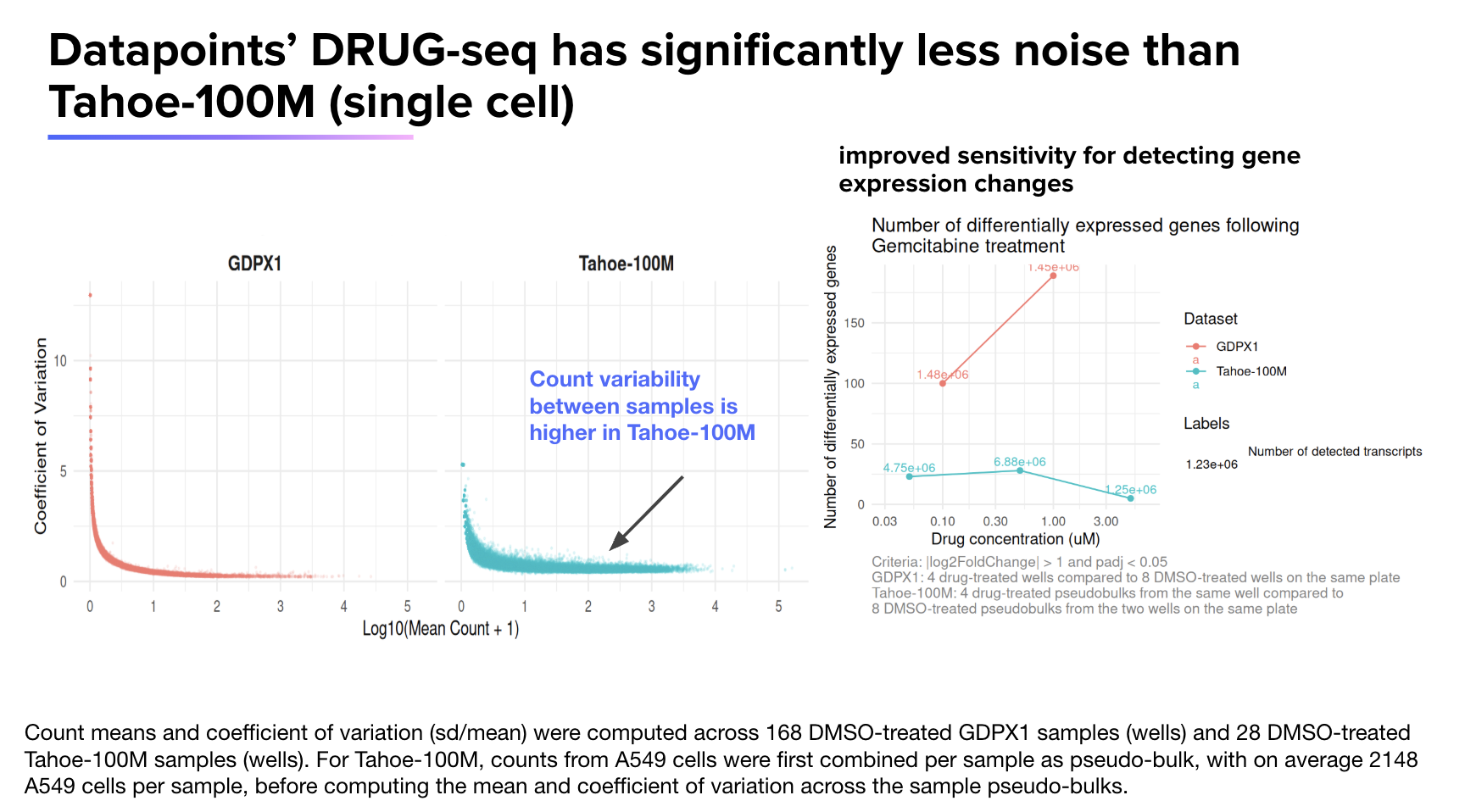
Proudly, what we lose in single-cell resolution, we make up for in higher signal-to-noise. This is a worthwhile trade-off, especially when you consider that many single-cell datasets are averaged into "pseudo-bulk" replicates as a first processing step anyway.
There’s a data addiction in our field, an attitude that "more is better." Like sugar, “more” can mean empty calories in some contexts.
For us, better is better.
Why We're Doing This: Pharmacology & Reproducibility
When anyone is asked about virtual cell applications, the number one answer is drug discovery. Yet there is a striking lack of public RNA profiling data with chemical perturbations.
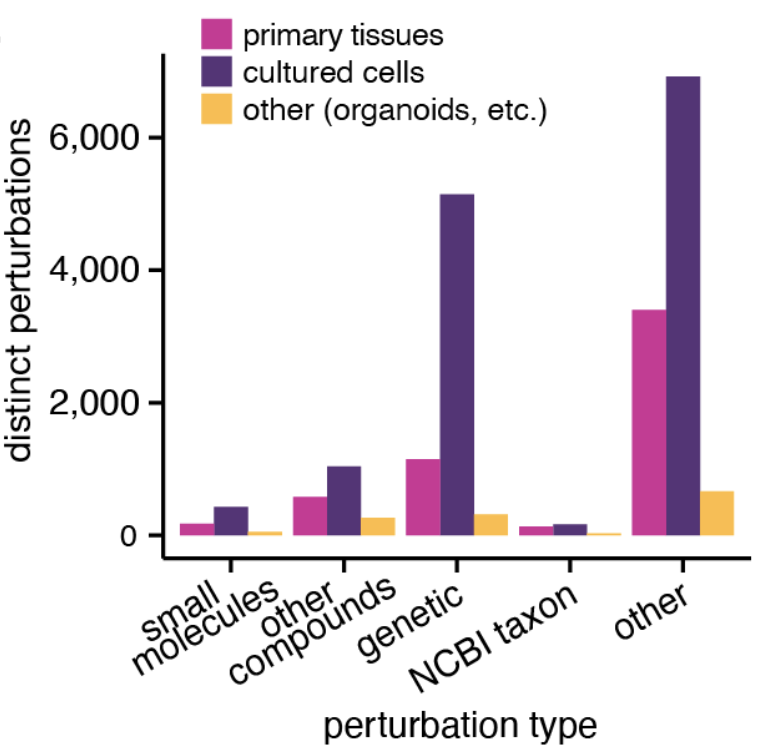
L1000/CMAP was transformative, but how old is it now? To make a drug, we need—wait for it—measurements on drug-like molecules.
Being able to predict the transcriptomic response of a cell type to a chemical structure would be a holy grail for AI-driven drug discovery (AIDD). But we need to learn to walk before we can run.
At the same time, is it just me, or have the alarm bells gone silent on the scientific reproducibility crisis? It’s as if we’ve forgotten that ~70% of pre-clinical experiments were found to be irreproducible, and $28B/year is estimated to be wasted on irreproducible research in the US alone. Scientists themselves know they have a problem (of 1500 researchers surveyed, 75% report not being able to reproduce someone else's experiment, while 60% report not being able to reproduce their own), yet not all are willing to address it. In 2016, 34% of researchers had not implemented procedures to increase reproducibility. Nowadays, there’s a quiet assumption that AI will fix this. But how can it? The saying holds: garbage in, garbage out.
We’re tackling this two ways:
Automation: For pharmacogenomics and transcriptomics, results can diverge wildly from lab to lab (Haibe-Kains, see pseudoreplicates in Koytiger). Automation is the key. Ginkgo has invested over $1 billion in our infrastructure. We know very few can match that, which is why we’re opening our platform to the community.
A Standardized Cell: The other challenge is cell drift. Everyone has their own "version" of [insert cell-line here] (Ben-David, Weiskirchen). We're bringing biomanufacturing-level rigor to research with the introduction of V-Ref293, a novel engineered cell line designated specifically as our reference standard for virtual cell research. It’s a controlled biological baseline—an organic twin to the virtual cell—secured through a master cell bank that captures the system at a defined point in time, minimizing drift while enabling reproducible digital modeling.
Announcing the Virtual Cell Pharmacology Initiative (VCPI)
This brings us to today. We’re incredibly excited to launch the Virtual Cell Pharmacology Initiative (VCPI), the first project under The Virtual Cell bio-AI community platform, powered by Ginkgo Datapoints.
On the heels of amazing developments from CZI/Biohub, Arc Institute, and others, we wanted to substantively contribute. This field is difficult, and we all benefit from a diversity of approaches. Here’s ours.
Instead of just building a dataset and dropping it on the community, we're launching before the data exists. We want to build this with you.
As our commitment, we are gifting the community 100,000 compounds of free RNA profiling data -- in dose response!
We're building the first public, large-scale, pharmacologically-relevant dataset for virtual cell modeling from the ground up.
Join Us. Build With Us.
Community building starts from day one. All we need from you is 50 µL of your compound at 10 mM shipped to us. You cover the shipping; we’ll handle all the rest.
Worried about IP? We’ve got you covered. You can opt for a 90-day embargo before public release or even keep your data permanently proprietary for a fee. This is the first time a service like this has been offered, de-risking the characterization of your unknown compounds, paying if you like what you see and want to keep it for yourself, or otherwise releasing it to the community.
Want to get involved? We're inviting researchers, pharma companies, and AI developers to submit libraries, vote on compounds, and share models. We want to incentivize active engagement over passive downloads. Data will roll out monthly, and active "super-users" will get early access.
We can’t wait to see what you all do with these data. We’re inspired by the impact of other transcriptomic initiatives like CMAP/L1000, and we hope this provides a new spark for the field. Beyond transcriptomics, there are many many additional avenues to explore (Roohani, Kosuri, Yapici). VCPI is the start. The Virtual Cell is the space where the bio-AI community makes its future.
Registrations are now open. Let’s go build.
Learn more and sign up at https://thevirtualcell.com.
As excited as we are about building the Virtual Cell, the project doesn’t impact our work with our current (and future) customers. We continue to offer custom premium functional genomics services in any biological context of interest. Got questions? Reach out at https://datapoints.ginkgo.bio/contact.