
Bispecific Antibody Developability: Design Rules and a Public 160-Member Dataset
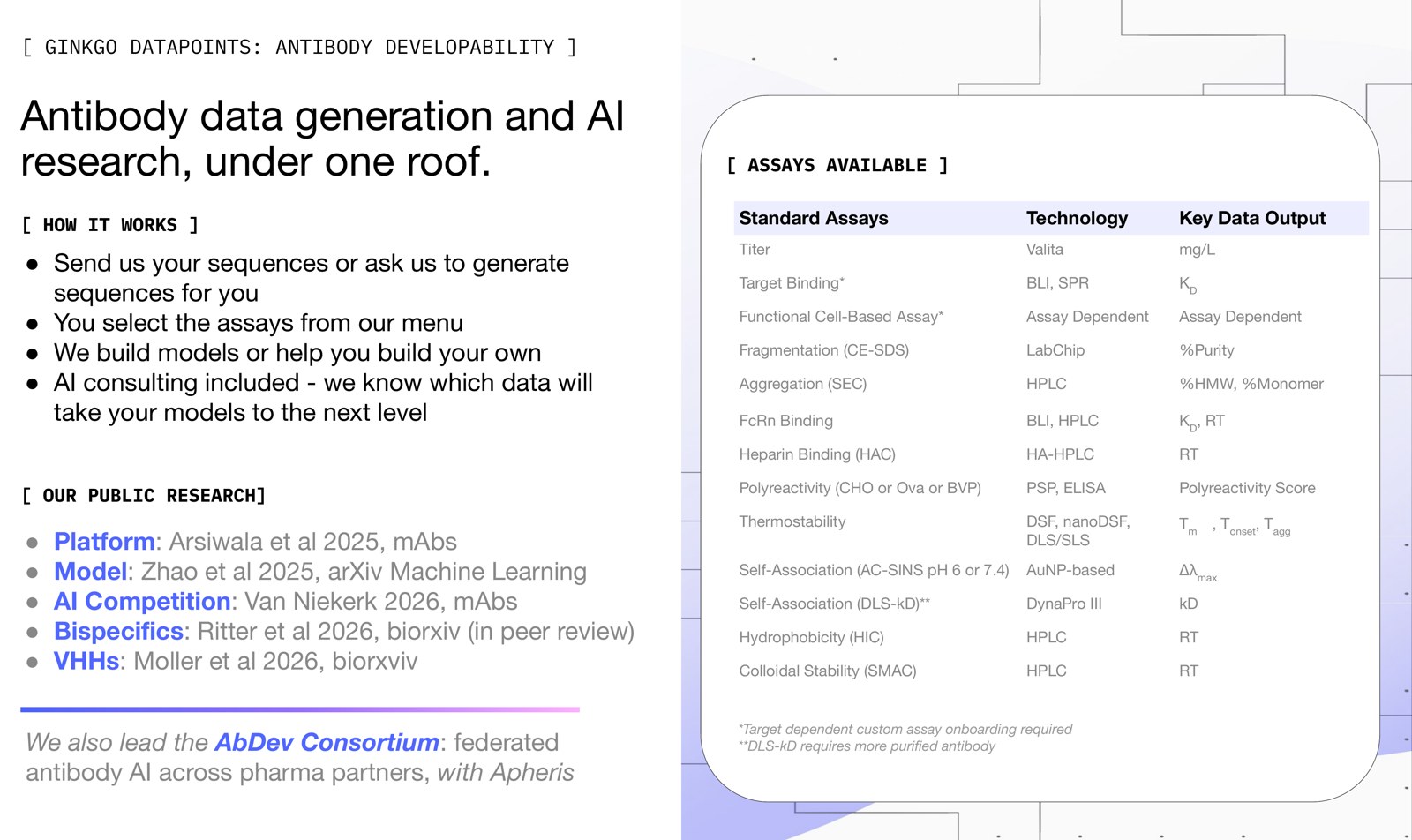
We profiled 160 bispecific antibodies and their 65 parental arms across 10 developability assays on PROPHET-Ab, and released the dataset publicly alongside a bioRxiv preprint.
Bispecific antibodies can do things monospecifics cannot, but emergent self-association, polyreactivity, and aggregation often make them less developable than their parental arms. Whether bispecific developability is inherited from the parents or driven by the format had never been tested at scale.
What we did
We characterized 160 bispecific antibodies and their 65 parental arms on a uniform knobs-into-holes CrossMab IgG1 scaffold across 10 assays on the PROPHET-Ab high-throughput platform, and released the dataset publicly.
What we found: three classes of inheritance
- Inherits cleanly: hydrophobicity and surface charge (Spearman ρ ≈ 0.85–0.95), so screening at the parental level predicts bispecific fate.
- Inherits partially: self-association and polyreactivity (ρ ≈ 0.60–0.88), with interpretable outliers driven in part by Fv-Fv charge complementarity.
- Poorly predicted: thermostability (ρ < 0.4), which needs bispecific-level testing.
Practical selection rules
Triage hydrophobicity and charge at the parental level, avoid pairing two high-HIC × high-HAC arms, pair opposite-sign Fv charges to suppress self-association (then re-validate in formulation buffer), and measure thermostability on the bispecific itself.